
How to Run a Same-Page Meeting: Sync Up or Seek Help
This article goes out to any founder, owner, CEO, thought-leader, or visionary who relies on that person they consider their right-hand!
At Backstage Ops, we're aligning Systems, Software, and Support Staff... and sometimes the “peopley” parts of the work are loud/complex enough that it's hard to make much headway on anything else.
While we stay within our scope of being experts on systems and processes... There are people-focused systems/tools you can implement to make the people-ing side more manageable. One of the most common operational breakdowns I see in small businesses isn’t strategy, talent, or even execution.
It’s misalignment at the top.

Not dramatic blowups. Not an obvious conflict. Just subtle disconnects between the visionary and their right-hand person—the COO, integrator, operations lead, or second-in-command… slowly eroding trust, clarity, and momentum.
That’s why I want to talk about same-page meetings.
This practice comes from the EOS (Entrepreneurial Operating System) toolbox, most notably outlined inTraction by Gino Wickman and reinforced in Rocket Fuel, co-written by Mark C. Winters. Even if you don’t run on EOS (and many of our Backstage Ops clients don’t), this practice is one of the most valuable investments you can make in your leadership relationship.
What a Same-Page Meeting Is (and Isn’t)
Same-page meetings are formally defined in Traction as a monthly meeting between the visionary and the 2nd in command to “reconnect the circles.”
The goal is simple but powerful:
Clear the air
Resolve issues
Address frustrations before they fester
Ensure leadership is unified before decisions ripple outward
A same-page meeting is not:
A tactical operations meeting
A project update
A place to solve day-to-day issues
A performance review
It is:
A leadership sync
A relationship investment
A philosophical alignment check
A space for honesty, candor, and trust
I often describe it as a heart-to-heart for the business.
This is where you talk about:
Philosophical differences
Frustrations that haven’t been voiced
Energy levels and personal context
Resentments that might be quietly building
What’s feeling unclear, heavy, or misaligned
Hard things get said here—by design.
At Backstage Ops, we work with leaders who use all kinds of operating frameworks—or none at all. And regardless of the operating system, this practice translates beautifully to any visionary + right-hand partnership.
You might call that person:
COO
Fractional COO
Integrator
Operations Director
Chief of Staff
Head of Business
“The person who actually makes this thing run.”
Titles don’t matter. The relationship does.

Why Same-Page Meetings Matter More Than You Think
When leadership isn’t aligned, everyone knows.
Gino Wickman puts it plainly in Traction: when partners—or visionary and integrator—aren’t on the same page, the team can feel it the same way kids sense tension between parents. Even when leaders think they’re hiding it, it shows up in mixed messages, inconsistent decisions, and quiet confusion.
In speaking and thought-leadership businesses, this problem is often amplified.
Most speakers are fast-moving visionaries. Ideas come quickly. Energy shifts. Priorities evolve mid-flight. And the person tasked with translating that vision into reality is often left trying to hit a moving target.
Same-page meetings exist to prevent that.
They create a dedicated, protected space for alignment—before misalignment leaks into the business.
My Perspective: Learning This from the Source
When I went through the Integrator Masterclass at Rocket Fuel University (an EOS Worldwide program), I had the opportunity to learn directly from people who helped write Rocket Fuel—including Mark Winters.
At the end of the program, we did an IDSing-style session (EOS language for Identify, Discuss, Solve—basically, bring your hardest issues to the table and work through them).
Over and over again, participants raised the same concern:
“How do I get into alignment with my visionary?”
“Who actually calls the shots when we disagree?”
“How do I coach ‘up' without creating tension?”
“How do we stop stepping on each other’s toes and confusing the team?”
And nearly every time, Mark’s answer was the same:
“That’s a same-page meeting conversation.”
Not an offhand Slack comment or a rushed agenda item in another meeting, and definitely not something you can afford to avoid altogether. It’s something that you intentionally plan…because you know it’s important.

Making Same-Page Meetings Work for Speakers
In speaking businesses, the visionary is often:
The brand
The revenue engine
The owner writes the checks
That creates a power dynamic that can make honest conversations hard—especially for the person supporting them operationally.
Same-page meetings level the field.
They say:
“This relationship matters enough to protect time for it.”
They also prevent a common trap we see:
Operational leaders absorbing frustration silently because “the speaker is busy” or “there are always more urgent issues.”
If there’s never a right moment, resentment fills the gap. So, how do we make these critical meetings work for our speakers and visionaries? Let’s talk through a few tips for holding your own Same-Page Meeting…
How Often (and How Long)?
From Traction:
Once per month
2-3 hours (Ideally, block off an afternoon when you can wrap up your day and turn your brain off directly after)
Yes—hours.
This is not a 30-minute check-in. Alignment takes time.
For many of our clients, a 90-minute to 3-hour block works well, depending on the season of the business.
And it should be:
On the calendar in advance
Treated as sacred
Rarely (if ever) canceled
A Simple Same-Page Meeting Starting Point
Here are some practical questions and prompts you and your integrator can go over in advance of a same-page meeting to come in prepared to discuss:
On a scale of 1–10, how "in sync" do we feel right now regarding our current priorities, and what would it take to move that number to a 10?
What is the one specific thing I am doing—or failing to do—that is consistently making your job harder or slowing you down?
Where have I recently overstepped my seat on the Accountability Chart, and where do I need to let go so you can lead effectively?
What is the "elephant in the room" that we’ve both been ignoring for the sake of peace, and what is the cost of us not addressing it today?
What is one thing I can do this week to prove I’ve heard you, and how will you hold me accountable if I slip back into old habits?
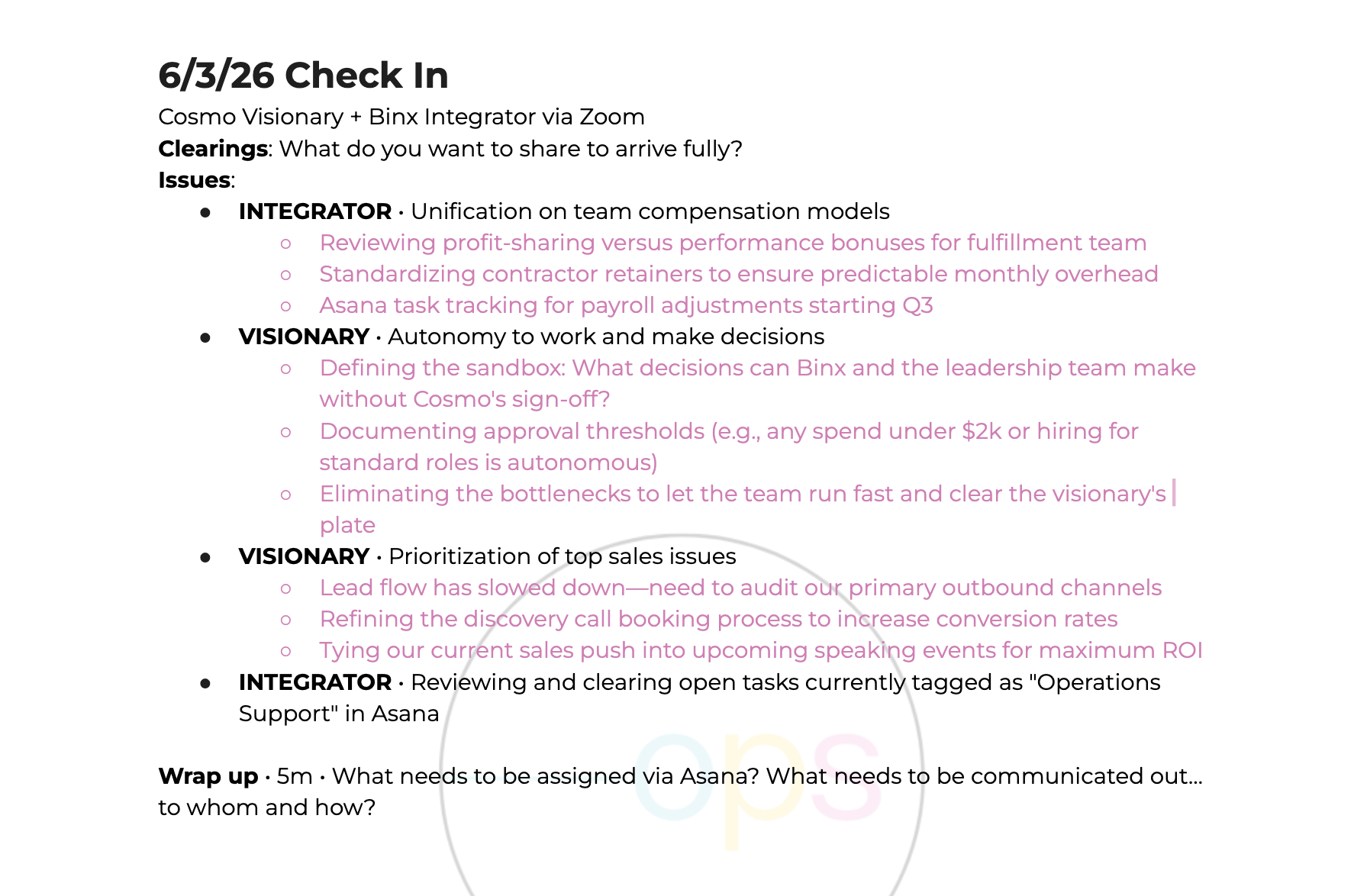
Pro tip: keep a shared running document where both parties can drop items throughout the month. These things are rarely top-of-mind when the meeting starts. Here’s an example of one of our running agendas with some same-page points for you to see:
The Biggest Pitfall We See
The #1 mistake?
Letting the meeting drift into day-to-day business.
When that happens, the real and uncomfortable conversations get postponed—again.
If you find yourselves deep in the weeds, pause and say:
“This is important, but it belongs in a different meeting.”
Protect the purpose.
Same-page meetings are about the relationship, not the to-do list. Those items can always be added to a more fitting agenda.

Why Candor Is Non-Negotiable
These meetings only work if both people are willing to be honest… and willing to listen.
That’s why I often recommend pairing this practice with reading:
These meetings should never be about being harsh. They’re about being clear, respectful, and human.
If you want richer same-page conversations, both parties need the language, permission, and skills—to be candid.
A Final Thought
Same-page meetings aren’t a magic fix for a leadership relationship that’s already broken.
They’re a maintenance practice—one that assumes there’s a shared commitment to the partnership and a desire to grow together.
If you’re currently in a place where you and your second-in-command feel fundamentally misaligned, tense, or stuck in ongoing friction, the work may need to start somewhere else. We’ve written more about that exact scenario in 👉“Are the Vibes Off with Your Second in Command?”, which focuses on diagnosing deeper misalignment and deciding what kind of reset—or decision—is actually needed.Or maybe your systems for communication are breaking down all over the place…in which case, you might want to find some additional clarity with our blog post on “Overcoming Communication Gaps”Same-page meetings come after that clarity.
They’re how you protect a relationship that matters. How you prevent small frustrations from turning into quiet resentment. How you make sure leadership alignment stays intact as the business grows and changes.
In Traction, Gino Wickman points out that when leadership is truly aligned, growth becomes simpler—not easier, but cleaner. Decisions land faster. Teams trust the direction. And the business stops feeling like it’s pulling itself apart at the seams.
If you’re a speaker building a real business—and you have a right-hand person you rely on—this is one of the most important investments you can make.
Not because it’s comfortable.
But because it keeps you on the same page.
Maybe you feel like it’s not just your second-in-command relationship that’s out of sync….but everything, book a call and let’s get you in alignment. 🪩
