
Overcoming Communication Gaps…Because Your Ops Can’t Thrive Without It.
For many thought leaders, communication is a core strength—until it isn’t. You might captivate an audience on stage, delivering a compelling narrative with ease. But when it comes to running your business, mastering clear communication can feel more like an episode of The Great British Baking Show—full of good intentions, a few happy accidents, and the occasional spectacular collapse.
Managing a team—whether it’s full-time employees, 10-99 contractors, or vendors here and there—requires time and energy that you don’t always have. The reality? There isn’t always space for thoughtful, perfectly crafted communication.
And while no one expects you to have Paul Hollywood-level finesse in every interaction, even small oversights—left unresolved—can plant a seed of distrust that grows over time.

The Subtle Challenges of Communication
If the following scenarios resonate with you, know that you’re not alone:
Hand Holding… You might feel that your vision is crystal clear, and maybe your team has been with you long enough that they should “just know” what to do. You hired them because they were competent and skilled, right? But even with the best intentions, when explicit expectations are missing, your projects can head right off the tracks—leading to preventable errors and leaving even the best team totally missing the mark.
Mums the word… Deadlines are getting missed, but only by a few days. Details are slipping through the cracks, but only really minor ones. Steps are getting skipped in your processes, but not the big ones. It feels easier to keep the peace and pick up the slack yourself, but eventually these small things add up to big things, and now your plate is too full, and you don’t even know how you got here. Getting to the bottom of small issues and asking questions may feel uncomfortable in the moment, but pay off in the long term.
Deja Vu Feedback… Minor miscommunications or unspoken expectations don’t just create small inefficiencies—they can become recurring frustrations. If these miscommunications don’t get fully resolved the first time around, you’ll most likely find yourself giving the same feedback and fixing the same issues over, and over, and over again. Like groundhog day for business leaders.
Stalled Decisions… When expectations aren’t clearly defined, even well-intentioned projects can stall. If you, as the leader, become the bottleneck—whether due to vague instructions, unclear deadlines, or an undefined version of “done”—your team is left spinning its wheels. If your processes feel like one big “stop and start,” it could be due to weak communication in areas that you’re not even aware need more attention and detail.
These challenges don’t come from a lack of skill or effort—they emerge because clear communication is an ongoing practice, not a one-time achievement. As a leader, balancing vision, execution, and team dynamics is already complex. The reality is, even when you’re doing your best, these struggles will arise.
But recognizing them is the first step toward building a culture of clarity, trust, and momentum.

The Solution: Clearer Communication for Clearer Operations
Directness isn’t about being blunt, aggressive, or hypercritical. It’s about clarity. It’s about opening channels where honest, constructive communication can thrive and your systems can flow. Here’s how to implement it effectively in your business:
1. Set the Expectation with a Strong Value Statement
From day one, establish that open, honest, and timely communication is the norm. Proactive team members bring up concerns quickly, and direct feedback ensures clarity and efficiency. Make it explicit, put it in your value statement, and share it with your team. “We prioritize clear, candid conversations. If something needs to be addressed, say it. Clarity is kindness.” Part of the reason we stress a strong value statement is for practical reasons like this. It sets the bar where you need it from the beginning.
Does your current value statement include your value on communication? If not, this might be the perfect time to reevaluate and update your statement.
2. Build the Model to Be the Model
Open communication will always start with you, but to be a model, you need to have it in your model. Set up quarterly one-on-ones, regular check-ins with team members, and other opportunities for communication on your calendar, in your systems. Models that make communication checkpoints a priority, not an afterthought, take the heavy lifting of making sure the talking happens off your shoulders.
If setting up all of those meetings and getting into that nitty-gritty work right now feels out of reach, there are broad ways to improve your communication model as well. Protocols on your preferences for communication, as well as best practices, eliminate guesswork and clarify expectations. For example, have specific channels for urgent and non-urgent communication (and honor them). Here’s an example of communication protocols that we use right here at Backstage Ops:
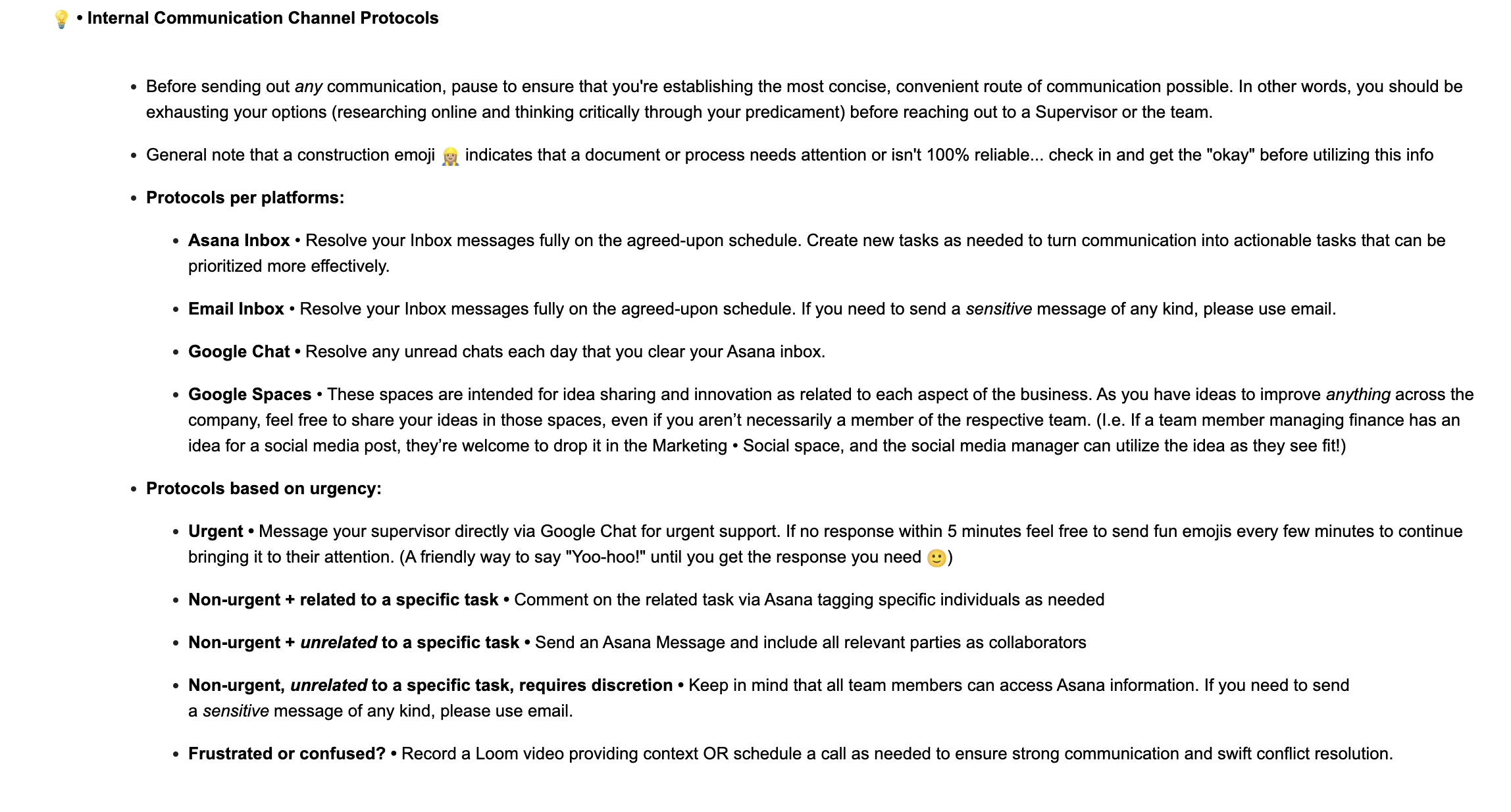
When opportunities for open communication are baked into your regular processes, the channels to exchange feedback stay free, and you might even be surprised by what you learn from team members.

3. Replace Assumptions with Explicit Clarity
Most friction inside teams comes from misaligned expectations. You think you were clear, but what you said and what was heard are two different things. The fix? Be specific. Replace broad requests with action-driven clarity: “Here’s what I need, by when, and what success looks like.”
They’ll never know unless you share with them. It’s easy to do, but we have to avoid assuming others know what’s expected and be incredibly specific (no more, “I thought you knew!”). For example, lead with curiosity, approach roadblocks from a place of grace. Instead of fearing the worst, get in the practice of assuming the best and ask questions to understand before offering what could be a misplaced correction or criticism. Try: “I see you have a red due date. What support do you need in getting it over the finish line this week? How much time do you predict for this task to take to get fully done?”
When defining tasks, it’s crucial to be clear about what “DONE” means. Avoid vague goals such as:
"Update the deck" (What slides? What level of polish? Is it for internal or external use?)
"Prep for the event" (Does that include speaker notes, tech check, or confirming the venue?)
Always over-communicate, because really, at the end of the day, there’s no such thing as too much communication. Define deliverables in a way that leaves no guesswork. This creates a standard everyone can align around.
Want more on this? Our recent blog, Harnessing Key Performance Indicators (KPIs) for Visual Growth, walks through how setting visible benchmarks can ground clarity in data and give your team something measurable to rally around.
4. Could This Be an Email?
Meetings are an investment of both time and money, so it's crucial to enter them with a clear purpose. Meetings need to be led by urgency and important updates rather than emotional top-of-mind topics. Before you suggest hopping on a call, decide two things: “what does my team need to know? Is this something that needs to be done face-to-face, or can it be done asynchronously?”
If you have trouble differentiating between which meetings need to be done together and which can be accomplished asynchronously, here are a couple of examples that can guide you: Is the conversation sensitive in nature? That’s a face-to-face conversation. Wordsmithing a document? Let Loom videos handle it. Brainstorming a new project or event? Collaborative meetings like that are best done in real time. Walking a team member through a new software? Send them a screen recording tutorial!
During your face-to-face meetings, ask yourself and your team: What’s unclear? What’s blocking progress? What decisions need to be made today? Be direct about which conversations are valuable for a live discussion and which can be relegated to a document for later review. This clarity not only drives real alignment but also ensures that every meeting is worth the cost. Ultimately, be real, be genuine, be authentic.

5. Build Accountability into Systems, Not Just People
If your operations are dependent on individuals remembering what needs to be done, things are going to get messy (louder for the people in the back!). Clarity isn’t just something you talk about; it should be embedded in your tools and processes. With clear SOPs, documented expectations, and structured follow-ups, you create built-in accountability that keeps everyone on track without the need for constant verbal check-ins.
We explore this idea in more depth in our blog on Boost Productivity Via Asana, where we show how to use project management tools to reinforce communication, consistency, and ownership. When your systems reflect your standards, you stop managing every task manually—and start leading with intention.

The Impact: More Freedom, Less Friction
When direct, honest communication becomes the default, everything runs smoothly:
Decisions happen faster because expectations are clear
Your team takes true ownership instead of waiting for permission
You spend less time in the weeds and more time in your zone of genius
Your business scales efficiently because clarity and accountability create momentum.
It’s okay if you’re not a master of communications just yet. What’s important is being able to take a look at the big picture, find where those clarity breakdowns are happening, and being able to adjust your operations, systems, and protocols to better serve you and your team. The solution exists, even if it takes time to implement it.
If your business is shifting from being all you to being shared with a team and you're tired of vague updates, missed deadlines, or just feeling like the only one who truly knows what's going on—let’s fix that. Book a disco call and let’s map out the systems, protocols, and communication habits that will move your business forward with less friction and more momentum.
